xoves, 22 de xaneiro de 2015
Thoughts on a Thursday
Haven't posted about Germany yet because my computer is in the shop, and typing at length is a pain on a tablet. Speaking of the computer repair shop, when I took it in, the woman said I had an Italian accent. Curious. Maybe it's from Galician influences, since I believe the Galician accent sounds Italian since they go up and down. Mamma mia! Anyways, yesterday they called me, which reminded me I need to work on my Spanish phone skills. And today I received a message from them in English. I'm not sure if I should feel offended or assume they just wanted to practice English. Then I imagined they had written a little note by my name: Do not call, doesn't speak much Spanish. Uh oh, let's hope not haha

martes, 6 de xaneiro de 2015
Felices Reyes!
 |
| Roscón and chocolate |
Uncoincidentally, last night was my first back in town after New Year's in Germany. With a few friends, we went out to dinner. It was packed with people dining on noche de reyes. Then we went out in the center, where there was plenty of ambiance and you could see lots of people more dressed up than usual for ultra-casual Lugo.
Today the traditional food is a round, yellow cake called roscón de reyes. In one piece there's a trinket hidden, and whoever ends up with that piece either has good luck, or has to pay for the next year's cake. I got to try roscón right before Christmas break at the school's chocolatada. There was Spanish style hot chocolate (meaning much thicker than American cocoa) and plenty of kings cakes. They even let me take some home.
 |
| Fer sandwich! Half of the English speakers at my school |
luns, 29 de decembro de 2014
Eguberri on!
This year's Christmas festivities were very Basque. On Christmas Eve (nochebuena) almost every barrio had their own celebration. In our hood that included a primary school parading and singing Basque Christmas carols, dressed of course in typical Basque attire. Zer polita! Seriously they were all so adorable. I even saw a baby dressed up with a baby-sized txapela (beret) to boot. A group of kids sang in a carnecería, which seemed like the cover of a Christmas card...or perhaps a scene from a Belén. Apparently they go caroling house to house for money, but with the economy the way it is, this tradition is becoming less frequent.
After lunchtime, Olentzero and Mari Domingi met and posed with the children of Donostia. Think Santa and Mrs. Claus, except Basque. At nightfall various children's dance groups paraded along with goats and Olentzero and Mari Domingi. The dances took me back to when I took a dance class here in 2012. I had forgotten most of them!
Christmas Eve dinner was early by Spanish standards: we started nibbling before 8! It was a pretty solemn Christmas, with no gifts exchanged. There was, however, an abundance of shouting. Seriously, for 4 people (not including myself because I didn't say much) there was a lot of noise. Discussing politics, love interests, and memories all required yelling. That's Spain though. As is going out after Christmas Eve dinner...
 |
| View from the house of children dancing in the street |
After lunchtime, Olentzero and Mari Domingi met and posed with the children of Donostia. Think Santa and Mrs. Claus, except Basque. At nightfall various children's dance groups paraded along with goats and Olentzero and Mari Domingi. The dances took me back to when I took a dance class here in 2012. I had forgotten most of them!
Christmas Eve dinner was early by Spanish standards: we started nibbling before 8! It was a pretty solemn Christmas, with no gifts exchanged. There was, however, an abundance of shouting. Seriously, for 4 people (not including myself because I didn't say much) there was a lot of noise. Discussing politics, love interests, and memories all required yelling. That's Spain though. As is going out after Christmas Eve dinner...
 |
| Basque scene from a Belén in a plaza |
sábado, 27 de decembro de 2014
Txotx!!*
There are about to be a bunch of posts in a row because it's the holiday season, and I've been doing stuff worth writing about.
This year thanks to my anaia adoptivo (host brother), I feel that I got the authentic Santo Tomas experience. The festival is celebrated in Donostia and other Basque towns the December 21st. Its roots are the baserritarrak (Basque farmers) coming to town on this day to sell animals and goods. Now it has morphed into a day of sidra and txistorra for all citizens wanting to pay homage to those traditional Basques.
 First of all, the weather was wonderful, nothing like the late December you might imagine. We went to the center around noon to check out the herri kirolak (country sports) which included a group of men dragging a giant boulder. So Basque. Unfortunately we didn't see any aizkolari, which is my favorite herri kirola where they chop wood (see this entry from 2012).Then we began the fundamental Santo Tomas activity: consuming txistorra sandwiches and a bottle of sidra. Traditionally on this day txistorra, a sausage I prefer to chorizo, is eaten on a corn tortilla called talo. However, there were much more txistorra stands than talo stands, probably since making talo is more time-consuming and requires some skill. Therefore the lines were immense and we opted for eating our txistorra on regular bread.
After so long, part of the group broke off to play pelota vasca and we moved to the Parte Vieja which was packed. There was barely room on the streets for people to push in one direction--bars overflowed and people partied in the streets. Then my bro had to go to work, what a pity!
 I would've stayed on with his amigos who were very nice to me, the quiet foreigner. But when I went back to look for them, it was like searching for someone in a where's waldo convention due to everyone wearing the Basque outfit. Madre mía! Nevertheless, since Santo Tomas is a day festival, I didn't feel so bad returning home before Spanish dinnertime. Besides, I had sleep debt from the night before and the night on the train.
Lastly, thumbs up to San Sebastian for promoting reusable cups. I'd say the streets were much cleaner because of it. Also I believe they were giving 1 euro for every empty bottle of sidra collected. I like the way they think.
* txotx is what Basques say when they realize cups are empty and they're about to pour more. Needless to say, with such a big group it was yelled often
This year thanks to my anaia adoptivo (host brother), I feel that I got the authentic Santo Tomas experience. The festival is celebrated in Donostia and other Basque towns the December 21st. Its roots are the baserritarrak (Basque farmers) coming to town on this day to sell animals and goods. Now it has morphed into a day of sidra and txistorra for all citizens wanting to pay homage to those traditional Basques.
Then we headed to a less central plaza to hang out with the cuadrilla of my bro. Most of them were dressed in the typical outfits of the Basque Celebration: a loose black overshirt, a blue and white plaid handkerchief around the neck, and a black beret. (Cuadrillas are an interesting cultural difference I often forget about until I'm on the outside. Groups of friends stay together from very young until old age.) Anyways, we spent probably 5 hours drinking sidra in the sunny part of the plaza. Nearby they were playing club music in euskera, which actually exists. Also someone was renting out little cabezudos, so every once in a while you'd see a kid running around with an old man's head. Hilarious. There was even a Galicia stand selling octopus and Galician wines. Represent!
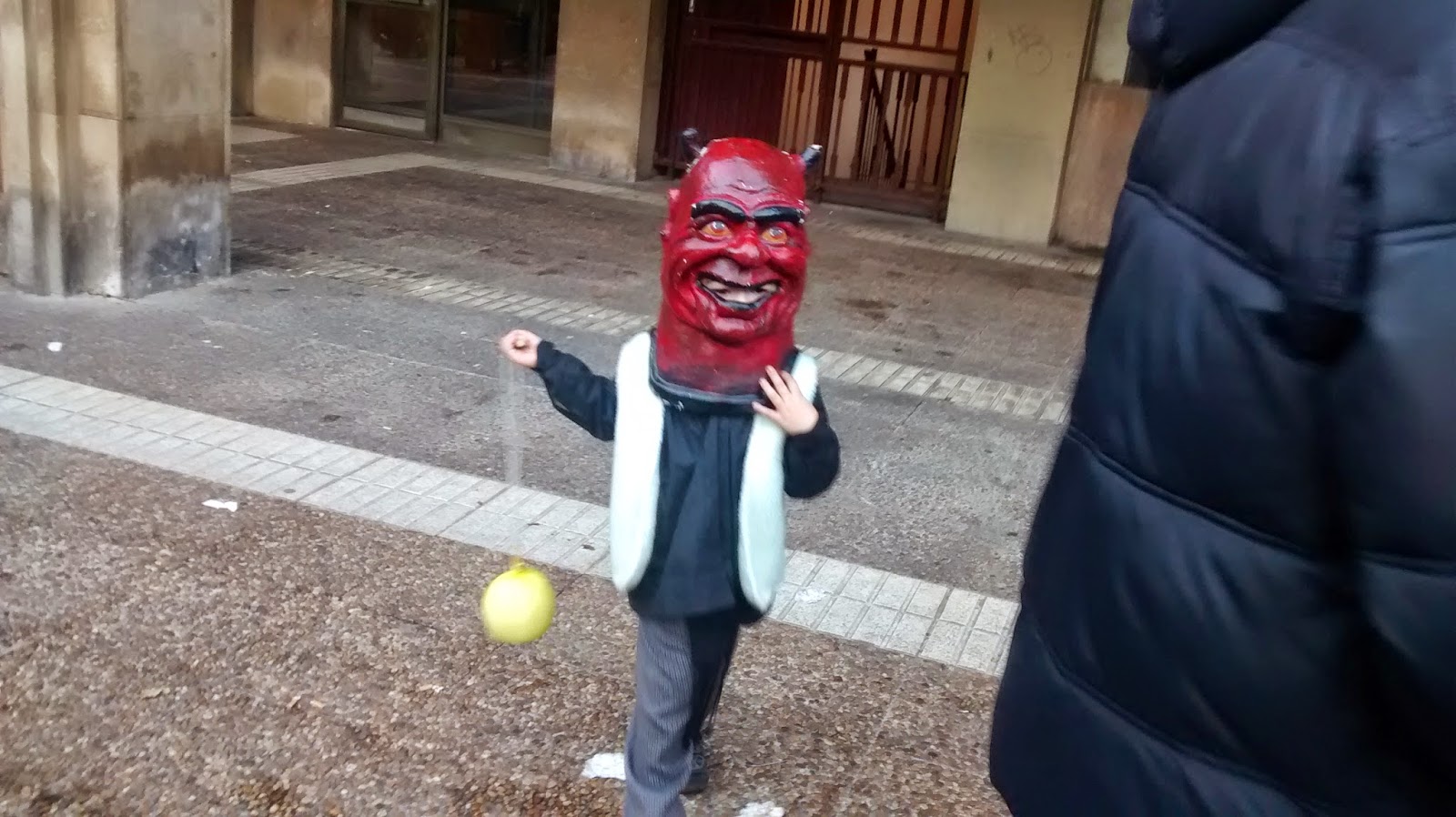 |
| Get behind me, Satan hahaha |
After so long, part of the group broke off to play pelota vasca and we moved to the Parte Vieja which was packed. There was barely room on the streets for people to push in one direction--bars overflowed and people partied in the streets. Then my bro had to go to work, what a pity!
Lastly, thumbs up to San Sebastian for promoting reusable cups. I'd say the streets were much cleaner because of it. Also I believe they were giving 1 euro for every empty bottle of sidra collected. I like the way they think.

* txotx is what Basques say when they realize cups are empty and they're about to pour more. Needless to say, with such a big group it was yelled often
luns, 1 de decembro de 2014
Another International Thanksgiving
Once again Lauren and I hosted a Thanksgiving dinner, except this year it was even more international. We had representatives from Spain, England, Brazil, Italy, and Angola.

THANKS TO:
Lauren for baking pumpkin pie, corn bread, and a type of apple strudel. Yum! This made the meal a legitimate Thanksgiving. And she majorly helped with the clean-up, knowing how I detest doing dishes.
Diego for seasoning one set of chicken thighs. A few minutes before putting the chickens in, I asked Diego, "So...what do we put on it?" He found a recipe and whipped up some dressing. And then at 9:20 when the gas tank went out before we had boiled the potatoes, he made 2 trips to the gas station to get more gas. Diego saves the day!
Alex for "teasing" the chicken. I always confuse the words vacilar (to tease) with vaciar (to empty). As you can imagine, I asked him to taunt the chicken. Once I corrected myself, he made fun of me for being "preppy" and then he realized the chicken came empty. Lucky break. I put the mushy stuffing in the bird myself --so much for being preppy!
The rest of our friends who came with desserts, wine, and good spirits. We ate by 10:30, and since dinner here is usually a smaller meal, everyone was thoroughly stuffed. Not to mention desserts (my new favorite is the Brazilian brigadeiros) Success! I was proud of myself for preparing the mashed potatoes, stuffing, and corn myself. Ok, frozen corn is not that difficult. But I'm starting to cook for people. Lauren and I are getting pretty good at hosting Thanksgiving...maybe next year we'll charge to get in. ;)

Lauren for baking pumpkin pie, corn bread, and a type of apple strudel. Yum! This made the meal a legitimate Thanksgiving. And she majorly helped with the clean-up, knowing how I detest doing dishes.
Diego for seasoning one set of chicken thighs. A few minutes before putting the chickens in, I asked Diego, "So...what do we put on it?" He found a recipe and whipped up some dressing. And then at 9:20 when the gas tank went out before we had boiled the potatoes, he made 2 trips to the gas station to get more gas. Diego saves the day!
Alex for "teasing" the chicken. I always confuse the words vacilar (to tease) with vaciar (to empty). As you can imagine, I asked him to taunt the chicken. Once I corrected myself, he made fun of me for being "preppy" and then he realized the chicken came empty. Lucky break. I put the mushy stuffing in the bird myself --so much for being preppy!
The rest of our friends who came with desserts, wine, and good spirits. We ate by 10:30, and since dinner here is usually a smaller meal, everyone was thoroughly stuffed. Not to mention desserts (my new favorite is the Brazilian brigadeiros) Success! I was proud of myself for preparing the mashed potatoes, stuffing, and corn myself. Ok, frozen corn is not that difficult. But I'm starting to cook for people. Lauren and I are getting pretty good at hosting Thanksgiving...maybe next year we'll charge to get in. ;)
venres, 28 de novembro de 2014
The Spain of Yore
Sometimes, despite the fact that everyone around me is speaking Spanish or Galician and has a certain European flair, I forget where I am. Probably because at this rate, Spanish life is the norm for me. But the other day as I was watching the Spain-Germany friendly (we lost...I don't wanna talk about it) at a bar, I got distracted observing the waiter delicately slice jamón off the cured pig leg. A few years ago I probably would've been disgusted. But now hanging pig legs are a common sight, although I don't always get to see them being sliced in action. Good ol' life in España.
 And since Lugo is by now just so "homey," I signed up for a craft course. Not only do I miss crafting at home, but it was a chance to practice my Spanish outside school/my apartment without it being an actual "Spanish class." It turned out to be an excellent decision firstly, because I love upcycling (the topic) and we made 3 projects which I can remake again and again. My favorite to make was the helix vase made out of rolled up magazines, because the weaving process was addictive. I also really liked the finish product of a candy dish made of newspapers. You would never know that it was made of just glue and newspapers!
Secondly the class was a success because of the women there. There were just two other "students" plus the teacher. All middle-aged women who were very nice to me. One insisted that I didn't have an accent, and they referred to me as "la chica," not as "the foreigner." At the end of the 4 day course, we arranged to go out for wine. Since I hadn't really explored the neighborhood the class was in, they wanted to show me the best place for tapas. At first the evening was uncomfortably quiet, but once we found a good topic, I was surprised by their stories of growing up in a Galician pueblo.
Although these women are as old as my parents, their stories seemed even more antiquated than those of my grandpa! The 1960s in rural Spain was similar to the 1920s in urban America. They said most of their food was homemade or homegrown, and for things such as sugar and flour, they basically traded what extra products they had such as eggs or crops. One woman remembered the day that electricity was installed in their house--it was such a novelty! Before that they used gas for lights, and town would be completely dark after a certain hour. So they walked home for miles with only the stars to light their way, crossing through woods and bridges in the dark. On the one hand that sounds idyllic, but on the other hand scary! Obviously they didn't even have a radio for the longest time, not to mention a television. And Lugo/Galicia was even more poorly connected back then. Barely anyone had a car, so they would walk an hour just to catch a bus to a big city. Or to get to Madrid...12 hours. But let's be realistic, now on a bus it takes you 9--not too much improvement there. Their tales also included stories of poverty, but they said they didn't notice because everyone was on the same level. Nobody had electricity, it's not like it was reserved for the rich people in the village. One woman recalled saving up to buy 4 walnuts and figs--one for each member of her family. And that they each had one was such a treat. She also remembered how she and her brother cried when the pig they were going to kill within 3 days died on its own, meaning they wouldn't be able to eat meat for months, because that pig was their one chance. Another said how all winter long they would have the chestnuts they had collected with milk for dinner every night. Hard to believe that all this happened in the second half of the 1900s, in a country we consider "developed." Evidently life during Franco's dictatorship wasn't as swell as he wanted people to believe.
Secondly the class was a success because of the women there. There were just two other "students" plus the teacher. All middle-aged women who were very nice to me. One insisted that I didn't have an accent, and they referred to me as "la chica," not as "the foreigner." At the end of the 4 day course, we arranged to go out for wine. Since I hadn't really explored the neighborhood the class was in, they wanted to show me the best place for tapas. At first the evening was uncomfortably quiet, but once we found a good topic, I was surprised by their stories of growing up in a Galician pueblo.
Although these women are as old as my parents, their stories seemed even more antiquated than those of my grandpa! The 1960s in rural Spain was similar to the 1920s in urban America. They said most of their food was homemade or homegrown, and for things such as sugar and flour, they basically traded what extra products they had such as eggs or crops. One woman remembered the day that electricity was installed in their house--it was such a novelty! Before that they used gas for lights, and town would be completely dark after a certain hour. So they walked home for miles with only the stars to light their way, crossing through woods and bridges in the dark. On the one hand that sounds idyllic, but on the other hand scary! Obviously they didn't even have a radio for the longest time, not to mention a television. And Lugo/Galicia was even more poorly connected back then. Barely anyone had a car, so they would walk an hour just to catch a bus to a big city. Or to get to Madrid...12 hours. But let's be realistic, now on a bus it takes you 9--not too much improvement there. Their tales also included stories of poverty, but they said they didn't notice because everyone was on the same level. Nobody had electricity, it's not like it was reserved for the rich people in the village. One woman recalled saving up to buy 4 walnuts and figs--one for each member of her family. And that they each had one was such a treat. She also remembered how she and her brother cried when the pig they were going to kill within 3 days died on its own, meaning they wouldn't be able to eat meat for months, because that pig was their one chance. Another said how all winter long they would have the chestnuts they had collected with milk for dinner every night. Hard to believe that all this happened in the second half of the 1900s, in a country we consider "developed." Evidently life during Franco's dictatorship wasn't as swell as he wanted people to believe.
Subscribirse a:
Publicacións (Atom)