domingo, 8 de abril de 2018

Daytrippers South of the Border

One benefit of living in Galicia is that Portugal is just a short drive away. When you cross the border, it's actually hard to tell the difference since the scenery is the same on the other side of the Miño River. While some insist that Portuguese and Galician are the same language, for me the  pronunciation is the only clue that you've made it south of the border.

On Palm Sunday we set out relatively early (especially keeping in mind that the hour hand had sprung forward). First stop: Tui. Given the holiday, we observed a procession of nearly 100 people around the town, following a statue of Jesus on a donkey. They didn't carry the palms we are used to back home; rather olive branches are more popular. Back in the day, people would leave the olive branch on their land since it was thought to bring fertility to the summer's crops.

I don't know why, but I was expecting Tui to be more magical. After all, it used to be a capital of the 7 Galician Kingdoms.  Tui's old town center is pleasant. But after seeing a lot of pretty, old town centers, I wasn't amazed. What did amaze me, however, was the information they had about Jews and the Jewish quarter of Tui. The Jews were kicked out of Spain in 1492. So in the north at least, vestiges of them are rare to find. In Tui there was a Jewish quarter and synagogue, with some carvings on houses still visible today.

Next stop: Viana do Castelo. This port town is on the ocean and also at the mouth of the Limia River. Atop the hill next to the city, overlooking the sea, is a big white church. In some ways it reminded me of Sacre Coeur, Paris. Similar church with lots of steps and a view below. Further up the same hill is a Celtic-turned-Roman camp. If it weren't for the Eucalyptus, there would be some great views. This was reminiscent of Castro de Santa Tegra, just an hour north on the same coast. For lunch we had a pair of Francesinhas, a typical Portuguese sandwich with various meats, melted cheese on top, and a plateful of its own special sauce. The main street was lovely, with views of the port in front of you, the white hillside church behind you, and along the road colorful shops and restaurants.

Our last stop was Ponte de Limia, an interior city on the same Limia River as Viana do Castelo. Because of the holiday, there was a big market set up under the trees along the riverside promenade. The highlight of the city, though, is a Roman and Medieval bridge which leads to another little white chapel. Coincidentally they were having a Craft Beer Fest which we checked out. And after a stroll through town we went back on our merry way to Galicia.

luns, 12 de marzo de 2018

Carnival Pt 2: Mud, Ants, and Medieval Castles

For the second part of Entroido/Carnival, we crossed the border back into Galicia. In the south of the province of Ourense, Carnival is alive and kickin'. The main sites are Xinzo de Limia, Verín, and Laza.

Little Pantallas
Our first stop was Xinzo de Limia. Despite it being a Sunday night, there were tons of people, 95% dressed in costume. Each town has their own Carnival characters, and in Xinzo they're called Pantallas, and so far are one of my favorites. Unlike the Peliqueiras of Laza, the Pantallas don't hit. They simply jingle-jangle down the street and every once in a while SLAM the two blown-up, hard cow's bladders that they carry. Usually they do this to people who aren't wearing a costume, but you can also hear SLAM SLAM regardless. And in Xinzo they start 'em young; there were at least a dozen mini-Pantallas running around town.

We turned in early for the night in Baños de Molgas, a quiet riverside village just far enough from the wild Carnival festivities to get some shut eye. The village has a spa, with the river washing up to it's door. Kind of like Venice, except I doubt anyone shows up by boat. Next to the spa is a natural hot spring, carved into a...washing station? A bath? I'm not sure which, and we didn't get in. The change in temperature made the area steamy though!

Next stop: Laza, home to some pretty wacky Carnival traditions. I had been to Laza before, except last time we arrived after the mudslinging, and only saw the destruction left behind. This year, however, we came prepared and ready to get messy. Both of us wore work clothes and arrived when the all-out mud fest was already underway. The tiny village's main plaza was divided into two ¨sides,¨ the common enemy apparently being cleanliness. An old bathtub was filled with mud and old rags. The tradition consists of throwing muddy rags, picking some off the ground, and repeating the cycle, until your hands go numb. As we approached, there were two who I deem the ¨Clean Police,¨ because they seemed to be targeting all the newcomers. ¨Take off your glasses!¨ Splash! A muddy rag rubbed in my face! Well, at least they let me take off my glasses. I kept them in the bar. But of course, then I couldn't see to aim very well (which made hitting people that much more rewarding). I'm also grateful I didn't suffer the same fate as other ¨clean¨ people who were thrown kicking and screaming into the mud bathtub.  In total, they were out there mudslinging for over 90 minutes. We sought shelter halfway through though. Mid February--that mud was cold!

In between messy Carnival traditions, we checked into our hotel which was actually a Medieval castle. In fact, I had been to visit it with friends three years ago when it was just an old castle to explore. Perfect place for a photo shoot of our Robin Hood and Maid Marian costumes! From the wraparound balcony, you could see the village of Verín below (including concerts at night), and miles of the rest of the valley. And with a welcome bottle of cava, we really did feel like royalty. That is, like count and countess.


Back in Laza for the evening, another strange tradition was about to begin. In the same main plaza from before people were starting to gather. But we went to join the festa in a ¨suburb¨ of the village, which is where the procession of ants and flour started. Yes, ants and flour. A small brass band got people psyched, as they brought out a giant ant figure. After a while, everyone walked back to the plaza, and that's where the real ants and flour started flying. By this time the plaza was absolutely packed, and we just ducked to the side of the road where people were already waiting. A few townspeople carried big sacks of dirt and ants, flinging them in the air. At one point, I wondered, 'Why are we subjecting ourselves to this? The mud can be fun, but ants!?' During the ant tossing, was flour shooting. They had what looked like leaf blowers, but loaded with flour. It's snowing! Kind of.

Blizzard? 

Follow the ant lord!
This concludes Carnival 2018. Galicia is one of the few autonomous communities where schools have a 5-day-weekend. But there are so many curious Carnival traditions within Galicia, it'll take years to discover them all. Wonder where I'll celebrate them next year...

venres, 16 de febreiro de 2018

Carnival Pt 1: Viva Pitões!

It's the most wonderful time of the year! As cold as Christmas, and everyone is likewise full of good cheer. Like in the rest of the north of the peninsula, Cádiz, and the Canary Islands, Galicia celebrates Carnival with costumes, traditions, merriment, and days off.

Robin Hood assessing the situation
For the first part of this year's celebrations, we went south of the border. Driving through the villages of Galicia, you know you're getting close to the invisible border when the car radio starts picking up mainly Portuguese-speaking stations. And the first stop beyond that invisible line is Pitões: population 200. On one side it has some rocky hills, and on the other miles of fields. Although the village is charming with red-roofed, stone houses, it's somewhat abandoned. There's a communal oven, a stone hut where they still make bread. It also has two bars in the ¨center¨ (re: a small plaza with said bars, and a multiuse building).

Some friends rented a house in quaint little Pitões, and we brought the festa with us. While in Galicia it's typical to dress up everyday for Carnival, in Portugal (or at least Pitões) not so much. The other visitors wore normal clothes, while our bunch was decked out. The day's festivities began with a handful of town elders in costume dancing and singing. Then came the band, who were Galicians too. They were dressed in traditional capes and animal hats. They kept the music going until the wee hours--and our group made sure there was always someone to accompany their playing with a muiñeira or paso doble. 

As night approached, we were in for a special treat. Gathered in the multiuse building (which during the day had held a small traditional food expo), were the same old ladies who had dressed up before and sold their homemade sausages and liqueurs. Except this time they were lined up, singing. Songs of yesteryear, I guess. Songs in Portuguese, but since Galician and Portuguese were once the same, some of our group knew the songs and could sing along. They taught us a very melancholic song, Viva Pitões! Then a few of the elders helped us dance in a round while they sung. Like Carnival ...circa 1920.

Vaia banda e vaia vistas!

mércores, 9 de agosto de 2017

Back by popular demand! And --Pardiñas

Long time no see! Thanks to encouragement from my loyal fans (lol) I'm getting back to blogging about mi vida galega. And since a dozen (or more) fascinating holidays/celebrations/trips have taken place since then, I'm aiming to churn out the entries this month. After all, I am on summer vacation! But between moving and family visits, I'm keeping myself occupied.

Let's start with the most recent: FESITVAL de PARDIÑAS
For the past 38 summers, Galician folkies, Celtic music fans, arts and crafts hunters, and anyone looking for a family-friendly fest have flocked to Pardiñas. It's one of the oldest music festivals in Galicia. And yet, music doesn't even begin to cover it. This year was my first time. The concerts start Saturday night, so I was surprised when we arrived by lunchtime. But plenty of others got there early too; the bar/tent sponsored by my bf's favorite social center was bumpin. Imagine a music festival, plus a bit of county fair with food stands, plus a few cafe/bar tents with food, plus dozens of craft stands in a field, plus tents of traditional Galician instruments, plus, plus, plus!

It's a good thing we arrived early in the afternoon, because Saturday they held a billarda tournament. While it looks like billiards in English, it's got nothing to do with it. Players in a field or court have a stick that's about 2 feet long. They hit a different, 6¨ stick lying on the ground so that it jumps up, and while it's in the air they swing at it. The goal is to hit it across the field, between two poles to score a point. It's an individual sport, and scoring...well I'm not 100% sure, but obviously whoever gets it in with the least amount of strokes wins. Anyways, the tournament was open to the public (I was too shy to try). Lo and behold, my boyfriend was the champion. Que enxebre, ese mozo! 

By the time billarda was over, the concerts began. It's not merely Galician folk music. There were also singers and bands from Canada, Mexico, Portugal, and Ireland. And at most rock concerts where there's a mosh pit, here there was a ¨muiñeira pit¨ where people danced to traditional Galician music. We, too, got our dance on--but mostly paso dobles and invented jigs. The music and festivities went on into the wee hours both Saturday and Sunday. But I can really only handle one night of fun, and even though my friends ¨came to visit¨ for the concerts Sunday night, I only lasted til about 1 AM. Oh well. Next year I will pace myself!

sábado, 28 de xaneiro de 2017

Island Getaway

Ah, the glorious bridges of Spain. And by bridges, I mean ¨puentes,¨ what they call long weekends in Spain, usually when the holiday falls on a Thursday or Tuesday, and they take off four days in a row to bridge the gap. Thanks to my already spectacular schedule, the week of the Immaculate Conception and Constitution day, I only worked one day: Wednesday. So we took advantage with a little trip to Mallorca. Roundtrip tickets to the Mediterranean island were cheaper (and quicker!) than a bus to Madrid--who could say no?
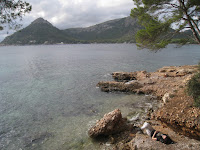
Sunning myself
The first thing in Palma's airport that caught my attention was that things were in 4 languages: Spanish and Catalan (obviously), English (also pretty typical), and German. People had told me there was a huge German population on the island. I thought they were exaggerating. But since it was winter, there was less tourism in general. Which in some cases, gave places a sad, ghost-town feeling.
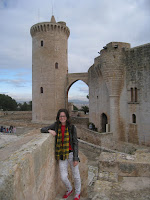
Castell de Bellver
We spent our first two days in the capital. In Palma we took in the typical sites, including the Cathedral, which even from kilometers away is prominent. La Loncha is the old fisher's market. Now it's simply a huge, empty space you can enter and almost feels like a cathedral. Palma's harbor is home to hundreds of boats: from dinghies with chipped paint to grandiose yachts worth hundreds of thousands of euros. A short stroll from the harbor, away from the city, is Castell de Bellver. It's a circular castle on a wooded hilltop. The open architecture makes it feel like a monastery. We also visited the Arabian Baths ruins. Unlike the Roman baths of Galicia, they are no longer functioning, but still cool to imagine. And as far as nightlife goes, we found a great, open bar that was playing the Clash all night long. Woohoo! Also we encountered so many sushi restaurants it almost seemed like a typical Mallorcan dish. Yum.
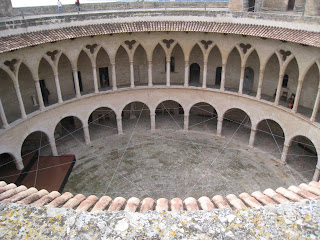
Castell de Bellver
From Palma the Serra de Tramuntana beckoned us.We quickly realized that the island itself is quite small, and we easily could have stayed in one central location and traveled to all of the island (it's all within an hour). But constantly switching lodging allowed us to see a lot of unique places. Anyways, the sierra is a World Heritage Site. This beautiful collection of hillside towns reminded me of a blend of Picos de Europa + Northern Africa + Napoli. My favorite town was charming Valdemossa, where all of the shutters are green. We caught the Port de Soller just as the sun started to go down, giving it a pink glow. Last but not least was Fornalutx, dubbed ¨the most beautiful town in Spain.¨ It's true that it was nestled in a valley, had some lovely cobblestone streets, and on the outskirts we found hens sitting in orange trees. Unfortunately, we got there after dark. In some ways it lost beauty, but in other ways it gained it.
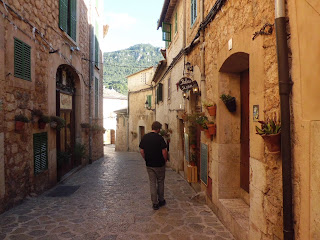
Valdemossa
Next we headed to the north of the island. Part of Pollença doesn't have coast, but it is between two mountains. We left early enough to check out the morning market--somebody wanted to bring back Mallorcan meat (sobrasada) and yet some how we forgot to buy the typical powdered sugar treat the size of a medium pizza (ensaimada)! From there, following the winding roads of Port de Pollença, we were rewarded with some spectacular views. Nothing but sea! And also because it was the off season, the resorts were closed and we had the beachy areas to ourselves. And since it's the Mediterranean and the temperature was decent, he even took a little dip. In December!
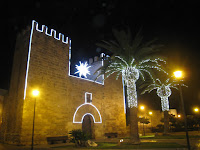
Oh little town of Alcúdia

That night we stayed in an old monastery outside the large town, Alcúdia. The monastery was at the end of a winding road, perched atop a hill, once again with wicked views of the sea. As we rounded one of the corners while returning at night, we came across a giant goat (horns and all) just sitting in the middle of the road. In the pitch dark. Just a few nights before Krampus was to come. Was this a close encounter with Satan himself?! We will never know.
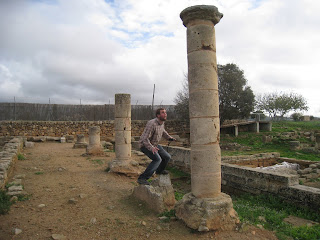
Hoppin around in Pol·lentia
Alcúdia was a nice place to walk around, even though it was quite empty. It has some remains of an ancient wall and a Renaissance one. (But again, living Galicia has spoiled me, seeing as Lugo has a Roman wall in its entirety.)  The next day we walked around the remains of the Ancient Roman city of Pol·lentia (go figure, it's in Alcúdia and not present-day Pollença). Those ruins included 3 domus, the forum, and an amphitheater. An amphitheater which one guide book pointed out is the smallest in Spain. Now that's something to be proud of! I'm all about Roman ruins though, so it was cool.

From there we headed to the east coast to the Coves del Drach. If these caves aren't a World Heritage Site, they should be. I like caves in general, but in addition to the normal cave fun, Drach has a big lagoon inside it. They make the entry cost worth it, because the tour ends in an open amphitheater within the cave, in front of the lagoon. They turn out the lights, and slowly a candle-lit boat comes a-rowin' towards the crowd with a quartet playing (in our case Christmas carols). Marvelous! After the concert, the public is able to cross the lagoon in the rowboats built for about 20. What an experience.

luns, 5 de decembro de 2016

Castañazo Rock

Castañazo Rock is a one-night rock fest in the town of Chantada which proves festivals aren't just for the summer. Really, that's their slogan. But actually with the weather the way it was, it felt like summer anyways. Castañazo isn't just a nighttime affair. Early in the afternoon, it starts off with a song contest, which unfortunately we missed. Eight groups go around to bars, singing traditional (drinking) songs, and basically getting people excited. The concerts themselves are held under the covering of the town fair pavilion. Which must be why at random points it smelled like cows. Also before the concerts were traditional games, which were really successful. You'd be surprised how entertaining simple games can be in this day and age. Then there was the magosto, aka free roasted chestnuts. Yum!

At Castañazo, we ran into many acquaintances. Well, for my boyfriend it wasn't surprising since all Galicians know all Galicians (that's my theory). Especially those on the alternative scene. But personally I was excited when I ran into some ex-students! ¨What are YOU doing here!?¨ They were perplexed because I guess they still think I don't understand Galician. We spoke in English. Fruits of my 2 years teaching them!


The concerts started off with Poetarras, who I've been listening to more and more often. Their songs are mostly to the beat of popular English and Spanish songs, but always with new lyrics and a social critique. There's a song dedicated to the governor of Galicia and to people who say things like ¨I'm not a racist, but...¨ Smaller crowd to start it off, but good fun. Then there was Familia Caamagno, a very dancy band with a 50s or 60s vibe. The next group seemed to be the one that drew the biggest crowd: La Raíz. I liked their mash-up of different music styles more than expected. Later was Esne Beltza, a cheerful Basque band, which was cool because I doubt many people in the crowd spoke Basque. There were more concerts after, but after standing for 7, I was ready for bed.

Camping was in a school gym. When we had pitched the tent, they told us to leave a path around the perimeter so that people could get to the tents in the back. But late arrivals must not have heard those instructions. The gym was packed with tents upon tents upon tents-- getting back was like traversing land minds. Ah, another fun tidbit: the sleeping area opened at 3 AM. But that weekend was the time change. So they really meant the old 3AM, the new 4AM. People had to wait in the cold outside in order to get to sleep. Some even got desperate and tried busting the lock. In the end we went in and fell asleep to the drunken lullabies of the other festivalgoers.