martes, 15 de marzo de 2022

(Blooming) O Bierzo

As I mentioned, this year I didn't experience any new Entroido traditions, but I couldn't just stay at home for five days in a row. So we took an express trip east to neighboring O Bierzo. Centuries ago, when Galicia was a kingdom (O Reino de Galiza), the region of O Bierzo was considered part of it. Nowadays, it's technically part of Castilla y León, even though there are some sections where they speak Galician. 
Pretty start
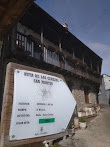
First stop: Corullón, a small village with specific hiking trails around their cherries. Since during the week before Entroido plenty of trees had been in bloom around town, I was hopeful. Cherry blossoms! Unfortunately, we are destined to not see cherry blossoms by the millions. This is the second time I have jumped the gun in terms of the spring visual treat. In the neat rows of around one hundred cherry trees, only ONE was blossoming. Thank you, early bloomer! I insisted I would go back later on this year, when cherry blossom season is in full swing. But now-- especially with the price of gas soaring-- I think it will once again have to wait til next year. We did spot a Romanesque church, however, so not all was lost in Corullón.
San Nicolás
Next stop: Villafranca del Bierzo. More of a town than a village, this was our home base for the night. At lunchtime it was sunny so first we got a drink in the main plaza which had a good amount of people. We sat at a terraza that seemed to be for the fashionable old ladies to socialize before going home to lunch. And here they also gave a hot tapa, garlic soup. For lunch we ate in a bar/restaurant decorated with dark wooden beams on the ceiling and a fire burning in the corner. Now that's what we call enxebre! But here's how you can tell O Bierzo is no longer in Galicia: when they serve a ¨spoon dish¨ such as soup or lentils, they don't leave the entire pot. This would be considered a crime in Galicia! I've heard of families who never return to a restaurant not because of poor service, high prices, or bad food, but because they didn't leave the stew pot for them to help themselves to seconds. It seemed weird to me that the waitress even brought the small serving pot of soup out. If she wasn't going to leave it, why not just bring out a bowl filled with soup? But I digress 😉

After that grave offense at lunch, we decided to get the coffee on the road. After a copious meal, we almost always stay to have a coffee and a shot of digestive liqueur. I myself don't usually partake in this tradition. On this occasion, getting our after-lunch drinks somewhere else encouraged us to walk around the rest of the town. Originally we had planned to explore in the late afternoon before dinner, but we saw just about everything in the hour after lunch. Aside from the aforementioned plaza, in Villafranca there is also a tree-lined avenue that seems to be the other area to get a drink on a terraza. For some reason, it was easy to imagine the town bustling in summer months. But at the end of February and on a Monday, it was pretty much dead. 

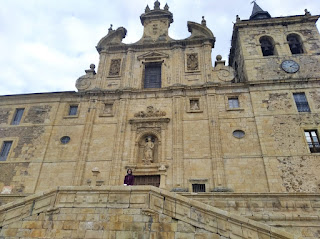
As far as sightseeing goes, Villafranca has two churches. It's on the camino to Santiago, and one of its churches is also called Santiago. It was a valid stopping point in case of injury. If someone had been walking for a spiritual debt, but got injured on the way, they could go to the puerta del perdón (door of forgiveness) in Villafranca del Bierzo and it would be considered forgiven. Then there's San Nicolás, an imposing building which has had a variety of uses including school, city hall, and church. There is also a round castle, but it's private so you can only observe it from afar. In general the town has lots of old architecture, and in some cases dilapidated. One cobblestone street is house after house with coats of arms, clearly the old wealthy road. 
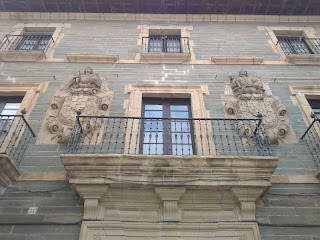
Coat of Arms, Calle del Agua

The ¨Royal Road¨
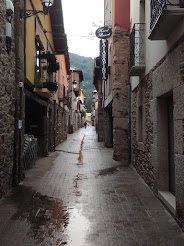
The following morning, we continued east, past Ponferrada, just to see the town of Molinaseca. The place is listed as one of Spain's Most Beautiful Villages. The moniker and village did not disappoint. Despite the rain and near-emptiness of streets, it was still an absolutely lovely town for a quick stroll. I'm adding it to my own personal list of places that remind me that I'm in Europe. That would be due to the cobblestone streets and dark beams on buildings. Flashback to the Middle Ages! It seemed more well-kempt than Villafranca del Bierzo. You could tell they lived off tourism and the Camino de Santiago. Leading out of the village is a Roman bridge, and on the outskirts is Shrine to the Our Lady of Sorrows. The doors are coated in metal sheets because apparently all the pilgrims used to want to take a splinter from the door. The view from this church was the trip's grand finale-- a blooming tree framing the village's other church in the background. Finally, some blossoms in O Bierzo!


mércores, 2 de marzo de 2022

The Sweets & Meats of Entroido

Aside from last year when Carnival was cancelled due to Covid, 2022 must be the first time I haven't celebrated Carnival heartily since I got here! This year, the only mask I wore was an N95, haha. I guess I'm saving my Carnival spirit for next year, when supposedly it will be ¨back to normal.¨

Entroido ears
Despite neither dressing up nor going out, I did have a little taste of Entroido last weekend. A true taste of those salty and sweet dishes typically served here. Saturday we had a cocido at home. Thinking back, my first experience with cocido was when I studied abroad in Donostia ages ago. After participating in Carnvial, we were invited to dine at the gastronomic club. Steamed vegetables, garbanzos, and meats were on the menu. At the time, I didn't even realize that it was a specific dish. Now I've made the connection-- cocido is a winter (or more specifically, Carnivalesque) dish throughout Northern Spain. When I worked in Becerreá, I would stick around for the cocido with teachers on Entroido eve. After that, though, I lost the habit. Until now.

Cocido literally means boiled. The ingredients of this bountiful, boiled meal can vary according to the region. Even within Galicia, there are some differences, depending on what produce is readily available in each house. In Lugo, the prototype includes garbanzo beans, steamed cabbage and potatoes, along with various cuts of pork. But in Vigo, for example, you might have turnip tops rather than cabbage or fava beans instead of garbanzos if that's what your family has in their garden.

The rest of this entry is not for the faint of stomach/vegetarians

domingo, 27 de febreiro de 2022

Galicia's Smallest Cemetery*

*Allegedly.

Cemiterio de Soutomerille
Last weekend we got back to hiking. We set off on a trail in Castroverde,  marked with poetically-written information panels. Away we trekked, past flat pastures of cows and little Celtic pigs, around a pair of churches from the pre-Romanesque to the last century, and through an enchanting forest with some enormously wide trees. The highlight for me, however, was the Cemetery of Soutomerille. Lost in the middle of the woods is this tiny enclosed cemetery. The moss covering it helps it blend in with its environment. The cemetery has only three vaults, less than a dozen ¨residents.¨ As far as I could tell with the tombstones, the oldest was buried in 1918. The stone edifices weren't as simple as modern-day mausoleums. Their shapes reminded me of hórreos, with two posts at either end. This could be attributed to stonemasonry being a typical trade long ago around these parts. 

On a different note, but related to Galician flora and fauna: the other day while driving home at dusk, I stopped just in time to observe a family of wild boar crossing the road! How exciting! It was the first time I had seen them in person, and from the safety of my car. There were two adults and three little piggies. In the past years, videos have circulated of wild boars running wild in the city streets at night. I think especially when we were confined back in spring 2020, they felt free to run the streets. I wouldn't go so far as to say it's the equivalent of seeing deer by the side of the roads back home. This is my first boar-sighting, whereas back home we see them so often it's almost no big deal. But according to my sources, I am equally lucky that they didn't storm my car. Apparently they can do as much damage as a deer would. 

domingo, 6 de febreiro de 2022

A Candeloria: Galician Groundhog's Day

There's no emblematic groundhog here, but the idea is the same. A Candeloria--February 2nd-- is a day to predict the winter's end. Will it stay cold and rainy? (Actually, this year has been really abnormal and it hasn't rained since last year) Or will spring start soon with Entroido right around the corner? There are several proverbs about the day in Galician. Summed up, they all claim that if A Candeloria is rainy or windy, winter is just getting started. 

So sorry, Punxsutawney Phil, but I beg to differ! This year on Februrary 2nd it was a clear day with spring-like warmth at lunchtime. And since it didn't rain, that means spring is right around the corner! The forecast concurs. While the Midwest USA gets battered with snow, it's supposed to get up to 60ºF in the coming week. 

Another saying about February 2nd is, ¨Pola Candeloria casan os paxariños.¨ Apparently on this day, the birdies wed. How sweet! Maybe that makes it a combination of Valentine's Day as well as Groundhog's Day! Even with an ocean between them, both holidays might have the same origins. February 2nd is around the day of the Celtic festival of Imbolc, celebrated in between the winter solstice and spring equinox. Then it got Christianized with St. Brigid's Day and Candlemas. And while nowadays not everyone around here even knows what A Candeloria is, the tradition makes for a good Galician comparison for English students learning about Groundhog's Day in the USA.


domingo, 30 de xaneiro de 2022

Spain: Destined to Lose Eurovision Once Again

Ah, Eurovision: the world's longest-running TV contest not solely for European countries. Recent participating countries include Australia and Israel. As an American, I just don't get what all the fuss is about for Europeans. One year I watched the international singing contest with my roommates. That was because I had no other plans, not because I was actively interested in seeing it. It also makes for a good topic to discuss the week after with some of my young students who are fans. We watch the best and worst performances and comment. 

While Eurovision itself is in late spring, the countries' internal competitions to choose a representative are well underway. In Spain, that task is relegated to the Benidorm Fest. Fourteen artists from around Spain were semifinalists, performing in the two concerts this past Wednesday and Thursday night. Way too early in the game for my interests to be piqued, but this year, like many other Galicians, the finals were personal. We were all rooting for our very own Tanxugueiras. 

As Tanxugueiras are a trio of Galician women who play the tambourine (traditional Galician instrument) as well as sing. Their music is a fusion of traditional folk and modern styles. Their song ¨Terra¨ got them to the semifinals and then finals in the contest to represent Spain. The hymn has a catchy ¨ai-la-la-la¨ refrain, typical in Galician music but usually not as epic as in this song. It's bewitching. Powerful. The message-- in addition to roots and feminism-- is, ¨Non hai fronteiras,¨ there are no borders. It would have been the first time ever that Spain sent a song in Galician to compete in Eurovision. Take a look at their performance and judge for yourself: 


While gathered around the TV, ready to support our ¨local team,¨ we also viewed the performances of the other seven finalists. Well, six, because one was confined with COVID. For me, the Tanxugueiras were fantastic, of course. The only other artist who stood out for me was Rigoberta Bandini with a catchy and yet somewhat radical tune, ¨Ay Mamá.¨ At that point, I had been bregrudgingly trying to accept defeat (said like a sports fan, who takes every team loss as a personal one) to her and her song. The crowd loved her --hey, they also loved the Tanxugueiras! And the song was good. In all fairness, both seemed like ideal options for Eurovision. Although once again, I am not a Eurovision professional. But most people agreed that these were the ¨only possible choices.¨ At no point did it cross my mind that the singer who ended up winning was even to be considered a potential rival. 

The system to determine who goes on to represent Spain in Eurovision works as follows: 

  • 50% of the score was based on the so-called ¨professional jury.¨ This jury was made up of three Spanish women and two European men, all related to the world of showbiz.  
  • 25% was based on viewer votes via texts messages and phone calls
  • 25% was based on the opinion of a carefully-chosen group of Spaniards meant to represent all of the demographic groups
As they announced the scores on Saturday night, the jury gave a pathetic amount of points to the Tanxugueiras. Unfortunately, this wasn't a huge surprise. Days earlier, the Galician trio had only been able to move onto the finals thanks to the public's high opinion of them. Afterwards it had also been revealed that while the two European judges had given the Tanxugueiras high scores, the three Spanish judges were the ones who skewed the count. In the semifinal, when the judges' scores had been revealed, you could hear the audience booing them, so much so that the festival host had to intercede. Back in the finals, in both of the categories based on public opinion, the Tanxugueiras got the MAXIMUM number of points. The people have spoken! But all thanks to the jury, they will not move on to Eurovision. Instead, Spain will be sending a singer reminiscent of J.Lo or Beyoncé. How original! We've never seen anything like that before!

As you can imagine, following this incident, social media in Galicia and even Spain was filled with outrage. How very democratic: the people selected their favorites and a jury of five people denied the whole country its preferred representatives. Could they not stand to see a song in Galician represent Spain in such an international competition? If that's the case, their selection isn't much more Spanish. The song is in Spanish, sure, but with a bunch of random English thrown in to be nearly unintelligible. It has also come to light that the winner has had a working relationship with one of the jurors. So much for an unbiased jury! 

Twelve hours later, and I am still just as outraged and incredulous. ¨Non me entra na cabeza,¨ it does't fit in my head; I cannot possibly fathom how some ¨professionals¨ thought that a run-of-the-mill reggaeton song was the best choice for Eurovision. Some have expressed hopes that Portugal takes the Tanxugueiras as their own and goes on to win the whole competition. After all, Galician and Portuguese were once the same language. That'd be wonderful, but I won't get my hopes up. All I can say is at least I'll have plenty to talk about this week with my students. 

venres, 31 de decembro de 2021

Spain's Christmas Lottery

When I first came to Spain, I was surprised at how big of a deal the Christmas Lottery seems to be here. All around there were signs in bars boasting ¨We have number 83194 for Christmas Lottery.¨ Months in advance! All sorts of clubs, associations, and places of employment often choose a Christmas lottery number for people to go in on together. At the school where I worked at the beginning of December there was a note in the teachers' lounge to sign up for the school's lottery number. Barely any teachers skipped out on buying the ticket. ¨This is going to be our year!¨ 

I wouldn't mind participating if tickets weren't so expensive. 20€ for a décimo. That translates to tenth, because with that participation you're entitled to one-tenth the prize amount. Obviously, the more numbers you have, the greater your odds. Which is why it's quite common for people to share with friends and family, having people buy numbers from different parts of the country. Someone I know spends around 200€ per year on the Christmas Lotto. And I'm sure he's not alone! 

An example of a losing ticket

There are people who even say the Christmas season starts here with the announcing of the Christmas Lottery numbers. Every year the numbers are announced the morning of December 22nd with pomp and circumstance. In a theater in Madrid, some fanatics wait outside for hours --sometimes dressed in costume--to get to see the number-calling in person. In a way, it reminds me of shoppers camping outside stores for Black Friday. Except instead of amazing deals, these people have their eyes set on thousands of euros. On stage, there are two huge, golden-caged balls. The bigger one has all of the possible number combinations. The smaller one has the prize amounts. The winning numbers are called out --or rather, sung out-- by children from a private school in Madrid. First a student sings the winning number, and the other sings the prize amount. ¨Mil eu-rooos,¨ is the most common. Every once in a while, however, a higher prize amount appears. There is one first prize, one second prize, one third prize, two fourth prizes, and eight fifth prizes worth 4 million, 1.25 million, 500,000, 200,000, and 60,000€ respectively. But of course the prize doesn't go to just one person. For every décimo, one tenth goes to you. So maybe the prize isn't as huge as the multimillion lotteries back home, but it is more distributed since lots more people than just ten can be winners. 

Plus, if your number is one off from any of the winning numbers, you aren't a total loser. One digit up and one digit down also get (a much smaller) prize. And if you have the last two digits of the first three winning numbers, you also get a small amount. Also, all of the numbers within one hundred of the top four prizes get a fractional amount. In addition, any numbers that end in the same number as the first prize get the reintegro, or a refund of what they paid for the ticket. With so many chances to win, I might even be enticed to play next year!