martes, 31 de outubro de 2023

Beware the Santa Compaña!

We interrupt this regularly scheduled recap of Greece to bring you some spooky Galician lore for Halloween. If you ever find yourself wandering the Galician countryside after midnight, beware of the Santa Compaña. This procession of dead just might be roaming right alongside you. They are supposedly dressed Grim Reaper-style with hooded robes. These lost souls also each carry a lit candle. You may not see them, but if dogs are howling uncontrollably, there's a mysterious breeze picking up, and a faint smell of wax in the air, the Santa Compaña is probably near.
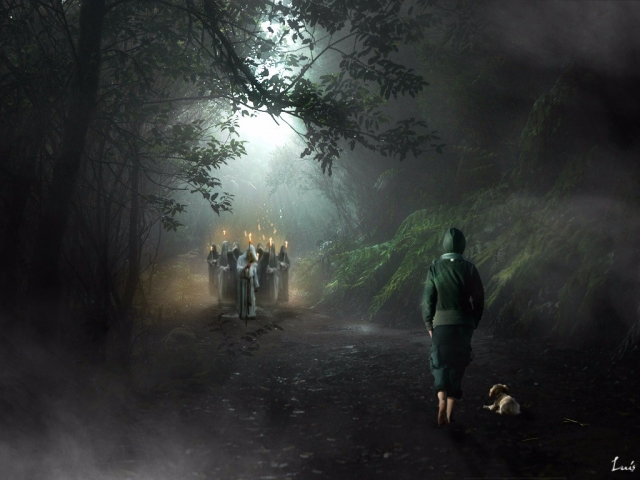
https://vivecamino.com/img/gal/santa-compana_4882_p.jpg
Santa Compaña depiction from vivecamino.com

What's even more haunting is that instead of being led by the Grim Reaper himself or similar, the Santa Compaña is actually led by a living person. According to legend, it is a man or woman depending on if the parish has a male or female patron saint.* Rather than a candle, they carry a cross and/or pail of holy water. Once you become the leader of the haunted parade, you must continue your role every night until you either die of exhaustion or find a replacement. If the living leader is lucky enough to come across another person during their nightly trudge, the baton is passed and the old Santa Compaña head is free at last.

Is there no escape from the doom of leading the Santa Compaña? It would appear that you have a few options aside from running away screaming. Apparently you can also lie face down or make a circle on the ground and stand in it. You can also stand on a cruceiro (stone crosses found all over Galicia) as if it were a base in tag. Keep that in mind the next time you spot some spooks in rural Galicia. Happy Halloween/Samhain!


*Note: Parish is a land division commonly used in Galicia, but not so much in other parts of Spain. It obviously comes from Catholic parishes, meaning the houses that geographically should go to one specific church. Nowadays it's no longer 100% religious. Each town council is divided into numerous parishes (parroquías), and those are then subdivided into ¨places¨ (lugares) or ¨neighborhoods¨(barrios). For reference, in Galicia there are a little over 300 town councils and over 3,000 parishes.

martes, 24 de outubro de 2023

The Birthplace of Western Civilization

Changing of the Guard
One of this summer's main events was spending two weeks in Greece. Making my grade-school Greek mythology geek's dreams come true! First stop was a few days in the capital, Athens. The red eye flight from Porto was useful in that we could take advantage of a full day. Not to mention the gorgeous blood-red sunrise as seen from the sky. 

After getting our bearings, the first step was to caffeinate. I'm not a coffee drinker, but when in Rome Greece, you gotta try the Greek coffee at least. We stopped in a shady plaza near a church. Despite it not even being 10 o'clock, the heat was already setting in. It was going to be a sweltering two weeks. My first experience with Greek coffee was grainy and bitter; certainly not enticing enough for a second experience. And this is where someone else's addiction to Frappes began. But with the heat, it was a no-brainer. Frappes seemed a more vacation-y beverage than just coffee over ice.

On Day 1 our big plan was to visit the Acropolis Museum. I really had high expectations, since from the little research I did, people raved about the museum, especially the upper floor, meant to resemble the Parthenon. The thing about high expectations, though...For me, it was disappointing. There was no audio guide to help you get into the experience. The displays to me seemed chaotic, although I'm sure there was a method to the madness that I just didn't understand. And as far as the top floor Parthenon, it was cool that they had so many copies of the detailed imagery, but since I was expecting to be blown away, I simply wasn't. 

Erechtheion (Temple to Athena), Acropolis

The Parthenon, Acropolis
Similarly, our morning at the Acropolis wasn't the best either. Although we had tickets, we still had to wait in line for ages just to get in. The heat was hard to bear. In fact, around the time we went, they ended up closing the Acropolis and other major sites during the hottest hours of the day, because a tourist had passed out standing in line. Yikes! And we went at 8:30 in the morning, but still it was toasty. And packed. I would recommend going in the evening when I bet it is less crowded albeit potentially no cooler.  Also, they had said that a fountain would be available once inside: a necessity under that pounding sun. But there was no fountain. At least there was a vending machine with cold water, which in Europe is limited to affordable prices (50 cents).

But I don't mean to be such a downer. It was really cool seeing those ancient stones, imagining going thousands of years ago to ask a favor of the gods, and being absolutely awed. So much history! Once again, the lack of map and audio guide was a bummer. However, you can count on Rick Steves to guide you and put you in the historical mood! In fact, one of my favorite historical sites in Athens was the Agora, and it's probably thanks to Rick Steves' audio guide (as well as a break from the heat--we went around 7pm). It was expansive, including a myriad of ruins and buildings, with a museum in the reconstructed Stoa. 

Stoa in the Ancient Agora

Another one of my favorite Athens moments was a special treat: cocktails on a rooftop bar. There are tons of options when it comes to rooftop bars and restaurants, more so than in any other place I've visited, assumedly for the Acropolis views. We went a little too early for sunset, but enjoyed our fancy selves just the same. Afterwards we had a good dinner for the same price as those two cocktails, but hey, once-in-a-lifetime trips deserve a splurge or two!

Booze with a View


mércores, 18 de outubro de 2023

The Return!

What better time to return to blogging than my favorite season, fall? (Or as all the English students here are taught, autumn.) While according to the calendar it's been fall for over three weeks, thanks to global warming, Galicia didn't get the memo until this past weekend. It had been sunny and in the 80s F (that's nearly 30ºC for all you Celsius fans) all throughout the first two weeks of October. Not normal. But now the temperatures have dropped and rain is the only symbol on the weather forecast. Time to light a fire and cozy up inside!

Seeing as the last time I wrote was almost a year ago, a lot has happened since then. It's been a big year! Including but not limited to family visits, international travel, moving, and the list goes on. The end of September also marked my 10 year Spainiversary! It's been a whole decade since I came to Galicia. Hard to believe. 

Anyways, this post was just to give fair warning: this blog is once again preparing for take off! So fasten your seatbelts and please make sure your tray is stowed and your seat is in the upright position. Or not.

venres, 11 de novembro de 2022

The Fair of Fairs in Monterroso

The other day I declared San Froilán Galicia's favorite fall festival. (Truth!) Now as far as fairs go, the top pick is once again in the province of Lugo, this time in the town of Monterroso. On November 1st-- a public holiday in Spain for All Saints' Day-- the hordes descend upon this town of 3,000, in search of a plethora of wares. The fair has been a staple for centuries. Its origins date back to over 800 years ago. Not to mention it's been recognized as a Tourist Interest within Galicia for over a decade. That's why they call it A Feira das Feiras, the Fair of Fairs. 

This year I was finally able to check it out. And although I had never been (pre-Covid, that is), it seemed to me that it had made a real comeback. The place was packed! There were cars starting about a mile away from the action in the center of town. They even had cops directing traffic. We ended up parking in a little ¨parish¨ on the outskirts, a 10 minute walk. 

¨3-story¨ stall
Once we got close to the center, the place was buzzing. Everywhere you looked: stands, stalls, people. Throughout the town, the stands were mostly selling clothes, socks, and shoes. One such stand blew my mind: whereas most had one to two rows of tops/pajamas/what-have-you hanging, this place had three rows. It was comparable to a 3-story shopping center amongst 2-story shops (complete with high prices for a fair, in my opinion). And apparently, in these situations with so much competition, haggling is perfectly acceptable. Not for me, though. I asked how much a pair of pants was, since the seller was so eager to see me ¨interested.¨ In the end, I wasn't actually interested. So as I was walking away, he called after me, ¨Chica! Wait! We can make a deal!¨ I honestly wasn't interested, but I'll have to save that technique for next time I actually am, hehe. I did buy a pair of fuzzy socks, but after the other incident, wondered, ´Did I pay too much?´

You may be wondering: And what about food? Inside a circular building made expressly for fair exchanges were the food stands. T'is the season for chestnuts, walnuts, and honey. In Galicia, meat is always in season. Therefore, there were tons of vendors to choose from with their chourizos, salted pork, and even pig faces. A handful of bakeries were there, as well as some stands selling fruits and vegetables. And dried beans. So many options! Clearly we couldn't leave empty-handed. We bought some chourizos, honey, an empanada for lunch, along with corn bread, raisin nut bread, and regular bread. Phew! If I were the octopus-eating kind, we would have sat down at one of several tents selling Galician-style octopus. (Fun fact: the typical style of octopus served in Galicia is actually called á feira, fair-style. Makes sense!)

In a traditional sense, a fair wouldn't be a fair without the animals. We actually just happened upon it, as it was kind of apart from the rest of the hullabaloo. According to someone who has recently studied many laws related to animals and food safety, the sale of live animals in this type of setting is no longer legal. And it was kind of sad to see some chickens cooped up in cages little bigger than themselves. I'm not sure how much dealing was actually going on. It seemed more like people were just there to gawk at the variety of fowls. Ducks, geese, and all sorts of chickens. A few decades ago (or less!) this was the spot for Galicians to come sell their cows. Now, it's just a type of zoo, in addition to all the food and clothes available for sale. 

xoves, 3 de novembro de 2022

Nutty November

Now that October has come and gone, our current chestnut count is over 55 kg. That's almost my weight in chestnuts! And while the harvest season is coming to a close, this isn't even the final tally. There are still plenty more to be picked up. For example, we haven't had our annual Magosto with friends yet. Usually we have people over in the afternoon so they can collect some of their own chestnuts to take home before we get down to roasting them over the fire and feasting on them in good company. Our chestnut-collecting goal is 70 kg. I think we're on target.

Jackpot 3-for-one
I guess like many foods I've started eating in Galicia, chestnuts have grown on me. They're quite sweet, and when boiled can be eaten like cereal in warm milk. Or when made into a cream similar to apple butter, they're to die for! But what I most enjoy is the satisfaction of collecting my own food. Buying them from the grocery store just wouldn't be as appealing. By now we've staked out which tree gives the big ones (whoppers, as I call them), and which aren't really worth our time. Within each spiky bur grow 3 chestnuts. Usually the two on the ends are a decent size, but the one in the middle is so slim it's worthless. Other times, there's just a huge one in the middle, in between two useless flakes of chestnut. But every once in a while you hit the jackpot. That is, you find three good-sized chestnuts all in one burr. Now that's efficient!

This year aside from the usual bounty of chestnuts we've been collecting from the half-dozen trees in the yard, we've also collected tons of walnuts since mid-September. And they still keep coming! I don't think we've ever had so many in this yard. In the past, we got dirty unnecessarily, but now we've learned that it's possible to get walnuts without staining your hands black. The walnut shells grow in a green, leathery skin. Sometimes they fall with said green (or black, rotting) flesh. Other times they break loose and can be found on the ground in just the light brown shells we all recognize. In the past we would try to pick off the green skin, thereby dying our hands for days. No need, apparently. As they ripen, they loosen themselves from the green and are easy to collect that way. We've got a few dozen kilos drying, all from just two walnut trees.

Usually I go foraging with my canine companion. I've renamed him the Nutcracker. When there were only walnuts on the ground, he'd be by my side, crunching on the shells. At first I was concerned that he was eating them whole. But as it turns out, he knows what's up-- he cracks the walnuts open and spits them out to only get the meat inside. Wonder who he learned that from. Now that it's mostly just chestnuts, he's taken to doing the same. Except, I don't think chestnuts are good for him. He mostly spits them out whole. What a waste of a chestnut!

sábado, 15 de outubro de 2022

Galicia's Favorite Fall Fest

If fall in Galicia is synonymous with chestnuts, then based on the 40-some pounds of chestnuts we've collected only in the past 10 days, I can ascertain with confidence: it's fall, y'all!

I know, I know, it's been fall for over three weeks now. But around here it sure hasn't seemed like it. Lately the weather has been so warm and sunny, you'd swear we were permanently living in the end of summer. The lovely weather was probably one of the reasons San Froilán this year was an absolute success for the masses. I'm sure it also had to do with the fact that this year marked the return to normal in a post-COVID-19 Lugo. While in 2020 and 2021, the city council tried to keep the spirit alive by programming ¨safe¨ concerts, it just wasn't the same. You had to groove to the music seated, masked, and separated from other attendees. That's why this year was a splendid return to San Froilán's glory days, with hordes circulating in the streets, gathering around concerts, greeting acquaintances passing by. 

Pulpeira behind in red

To make up for lost time, this year we went out not once, but twice. And I wasn't even impressed with the concerts, which is normally what would draw me out to the fall festival fun. The first time was accidental, really. In Spanish terms, we were merely going to ¨tomar algo,¨ to grab a drink and check out the atmosphere. That was the night before San Froilán, a holiday only in the city of Lugo, so there were only locals around and about (except for some vacationing retirees, that is). We ended up saliendo, going out until the late hours. The other occasion was on Saturday when we met up with friends for lunch. Although we didn't make it down to the casetas (temporary restaurants specializing in octopus), octopus was still on the menu. A San Froilán without octopus is hard to fathom. And since the pandemic, restaurants have been allowed to hire a polbeira/pulpeira (almost always  female octopus chef) to set up her stand outside. The one outside our restaurant had orders coming from every direction.

This year I also enjoyed checking out the rides and carnival-style games set up, even though I didn't partake. The menfolk tried their hand and darts, and do you think they came back with a prize? Of course not. But someone I know rode the Ratón Vacilón (silly name of a rollercoaster) twice. I was encouraged to go on, too. But I prefer real rollercoasters that are permanently stuck to the ground. 

Thursday was the fair's final day, a ninth day rather than eight. That concludes the San Froilán experience. Cooling temperatures, chestnuts galore, and changing leaves. Magosto is upon us! In fact, some chestnuts roasting on an open fire are in order this weekend...