luns, 25 de febreiro de 2019

Domingueiros, Dominguieras (Sunday Drivers)

Sundays without plans are a perfect opportunity for a drive south of the border; and northern Portugal still has many gems to explore. We usually take the ¨long way,¨ opting for quiet country roads instead of paying for the speed of the turnpike.

Arcos de Valdevez
Our first stop, and the ¨biggest city¨ on the agenda (population: around 20,000), Arcos de Valdevez was a quiet town on a river. Quiet, perhaps, because it was Sunday morning and people were at mass. It has twin churches at different ends of one plaza. A third church can be seen in the same line, but it's an odd shape for a church: a rounded square. In this town we tested out two different cafés and noticed some differences between Galicia and Portugal. The grocery stores were open, which on a Sunday in Spain is unfathomable.

Soajo
Espigueiros in Soajo
A short drive away, this tiny town is famous for its group of hórreos. Well, what Galicians call hórreos, the Portuguese call espigueiros. They are one in the same though: elevated stone or wooden granaries to store and dry grains above ground where mice couldn't get into them. In Galicia they are a common site in many yards in the countryside, with designs often depending on the region. In Portugal it would seem that the tradition was to have all the espigueiros gathered together, since the only ones I've seen in Portugal were in conglomerations. In Soajo, there are more than 20 grouped together on a huge slab of rock. They aren't used any more, but sure make for a pretty picture amongst the green and mountains.

Part of our adventure in Soajo included listening to google maps, which actually doesn't always know best. It sent us towards the village's fastest exit, which included hills, difficult turns, and not to mention incredibly narrow streets. We saw villagers' cars parked in their driveways, so we persevered, knowing it was possible to get through with a car. At one point the car scraped between two buildings. Glad it wasn't me driving! We ended up turning around anyways, because we were being led down a steep hill with a difficult turn at the end. Luckily a villager was passing by and helped direct the car towards the main road.

Lindoso
Lindoso Castle in background
Further into the Peneda Gerês National Park, which straddles the eastern part of the Galician-Portuguese border, is the hamlet of Lindoso. Here there were even fewer houses, but just as many espigueiros. Except rather than being on top of a rock, they were in the backyard of a castle. Delightful! The inside of the castle was closed, but we were able to walk along its outer wall and look out at the espigueiros. It was easy to imagine them full of corn to keep my castle and kingdom fed for the winter.

View from the castle

Between stops we came across some cows with HUGE horns, just chilling.

Sistelo
After lunch we headed to Sistelo, a hamlet surrounded by lush green hills. They took advantage of the hills by leveling off the land so that they could have gardens and place for animals to graze. To take in all the views, we went on a super quick hike to the church, down a steep set of stone stairs, over a river, and back up the stairs again. Not much to say here, the photos speak for themselves. Although they don't even do the green hillside justice.


Sistelo from the other side of the hill

venres, 15 de febreiro de 2019

Mondariz's Medicinal Fountains

Gándara Fountain
Mondariz-Balneario is the smallest town in Galicia. Well to begin with, they organize land a little differently here so let's review. Galicia itself is a comunidad autónoma (Autonomous Community) of Spain, divided into 4 provincias (provinces). Within these 4 provinces are 53 comarcas (regions). These regions are made up of 313 concellos, or town halls. These ¨town halls¨ are usually made up of one city/town, plus a little aldeas (hamlets, villages) and even lugares (sets of 2-5 houses). Mondariz-Balneario is only 2 square kilometers, next to the original town of Mondariz. Why bother separating? Because this part of the town has multiple springs of medicinal waters which when rediscovered in the 19th century, drew a lot of attention. It became a sort of theme park for the wealthy. The name of the town literally means Mondariz-Spa. Not to be confused with boring old Mondariz.
Troncoso fountain has seen better days.
You can still glimpse its fancier days though.

A charming riverside stroll takes you to the furthest fountain, Troncoso. The fountain is surrounded by an elaborate fence, and two sets of staircases lead down to it from the promenade. Nowadays, it's shabby. Yet it is easy to imagine that a century ago it was a fabulous place to meet your neighbors (or wealthy visitors). 

The other main fountain, Gándara, is right next to the Mondariz spa. This one is grandiose; reminiscent of an ancient temple or observatory. According to the sign, the water treats gastroenteritis, liver issues, diabetes, and cardiovascular issues, among other things. With that in mind, I gave it a try. Hint: it tasted sour and awful.
After scoping out the grounds, we headed into the Mondariz spa for some R and R. The spa was opened in 1873, and has since been visited by illustrious Galicians and Spaniards including authors, politicians, and royalty. At the turn of the 20th century, the Grand Hotel was opened to host these visitors in opulence. Due to a fire later on, it went to the wayside. But in the past decades it has been restored to its grandeur of the good old days. The ¨Water Palace¨ as they call it, is quite nice with plenty of different pools, jacuzzis, saunas, and showers. There's even a small thermal bath outside which was a wonderful contrast on a winter afternoon.

Nearby Mondariz is a castle and a castro (Celtic settlement) which we also checked out. Sobroso Castle is a medieval fortress that gets its name from the forests of cork trees which surround it. During the Irmandiña revolts, it was mostly destroyed, but was later reconstructed. Nowadays you can get in for just a euro, although there isn't much to see. We did, however, enjoy its exhibition on underwear throughout the ages. Most of Galicia's Medieval castles aren't the endless collection of rooms and secret passageways you might imagine. Or maybe that's what they want us visitors to think!
Sobroso Castle, view of tower from second floor guard path
About 20 minutes on horseback (I'm guessing; we used modern transportation) from the castle are the ruins of a Celtic castro. Over 1000 years ago, Troña Castro was a Celtic settlement with at least 30 homes. Its residents dug a ravine, which along with a wall, kept out enemy clans. And wouldn't ya know it, centuries later the Catholics decided it would be a fine place to build a chapel. Nowadays you can walk around the bases of the Celts' circular stone houses. You can also observe a mill carved into a rock. The castro is famous for its snake petroglyph, but we weren't able to spot it. 
Troña Castro

xoves, 24 de xaneiro de 2019

Ancestral dances and Galicia's Enchanted Forest

In Spain, every city, town, village, and hamlet has a saint. This is especially true in Galicia, since if you look at a map of place names including ¨Saint,¨ Galicia is covered in them. And for every saint, there must be a celebration! This past weekend was St. Sebastian's day. After living in Donostia-San Sebastián for a year, this feast day now holds a special place in my heart.
The tiny fishing village of Aldán in Galicia also celebrates San Sebastián day, but in a very different way. Compared to the 24-hour drumming of Donostia-San Sebastián, they have a low-key performance of what was called ¨ancestral dances.¨ After Sunday mass, the dancers prance and hop around the church to the beat of a bagpipe and a drum. This traditional dance is over 300 years old. Apparently it started as an offering to the saint to protect the villagers against the plague. 

Due to imperfect public transportation schedules, I missed the original dance around the church. But luckily for me, they repeated the dance later in the afternoon, near the church and again on the village promenade. The dance itself was made up of five female dancers, 10 male dancers, and one guide. The young women wore giant hats of flowers, and the men (most a lot older than the women) wore suits with a sash and played castanets. The dance itself was a simple swaying with some hops and swirls in between. The most impressive was that in the swirling, the women's massive hats never fell off.


Medieval Aqueduct
To take full advantage of the two bus rides to get there, I also explored the Enchanted Forest of Aldán. Before you even get into the forest, on the side of the road there's a cute mini-bridge and typical clothes washing station. The forest is like any other Galician forest-- they all seem magical. But this has the bonus of a huge Medieval aqueduct and the façade of a small castle. From what I gather, it was part of the land belonging to a small palace (pazo) nearby. The little castle was going to be ¨just for fun¨ for the owners. But it was never finished, and when the road was built right between the pazo and their yard, the forest became a charming park.

Little Unfinished Castle
All in all, it was a nice way to spend a Sunday (when there is often little to do but stay home). Some alone time in nature followed by a bit of Galician traditions to remind me that Entroido (carnival) is right around the corner!

martes, 15 de xaneiro de 2019

Tourism & Christmas Spirit in BCN

For Spain's long weekend in early December, I felt like going somewhere to get me in the Christmas spirit. At home, it is always snowing by December. I miss the snow! Originally I thought of going to the famed Christmas markets of Germany or Strasbourg. But when I saw the price tag, I knew a cheap, short plane ride to Barcelona would suffice. 😁 I was surprised to find the Catalan capital on a list of best European Christmas markets. I had already been to Barcelona a few times when I was studying abroad, but since I had gone to meet up with a penpal, I didn't necessarily see all the tourist destinations. This time around my guiri (tourist) needs were fulfilled, as well as my desire for Christmas joy.

La Sagrada Familia
In the blue-green forest
On my last visit to BCN, I just observed it from outside and went into a small chapel that's free. My memories of that chapel (meh) have nothing to do with the real deal. The outside of the basilica is just as elaborate as the inside, so it was worth spending the time checking it out. Once inside, the most outstanding characteristic is the stained glass. Not the artwork itself, but the light that pours in, dying the walls reds, yellows, greens, and blues. The pillars succeed at looking like a forest. And the ceiling was such a draw that there was a mirror in the center facing upwards so visitors could get a good look without straining. The basilica is beautiful and unique, for sure. But with all they hype, I wasn't blown away. Maybe I should have splurged and paid the full 22€ for an audio guide. I'm sure there are a lot of details I didn't pick up on that would've made the experience even better.


Casa Milà (La Pedrera)
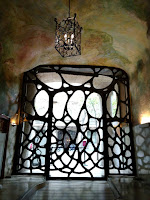
Continuing the Gaudí architecture tour of Barcelona was a private home he designed. In contrast to the Sagrada Familia, having the audio guide made it my favorite tour. It wasn't just a run-of-the-mill guide. Its sensors could tell where you were, and it would talk to you accordingly. It even had background music! For example, going up in the elevator to the rooftop it played intense music to get you pumped. And thanks to the audio guide, I focused on details I might not have picked up on. The repeated theme was nature, which could be found in the waves of design; the attic that was seemingly held up by a whale's backbone; the door patterned like a monarch butterfly; and the forest-like patio.
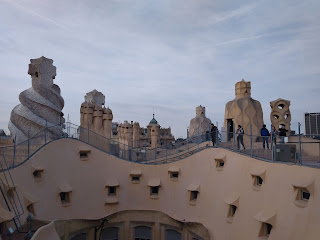
La Pedrera's Rooftop

The tour lets you see the first-floor patio, rooftop, attic, and the floor where the original homeowners lived, as it was. The building used to belong to the Milà family at the beginning of the 20th century. They rented out the other floors. Apparently there was drama because the wealthy neighbors of Passeig de Gràcia thought Gaudì had created a modern monstrosity. Now all the naysayers of yore have been proven wrong since La Pedrera is a UNESCO World Heritage Site.

Christmas Market-Fira de Santa Lucía
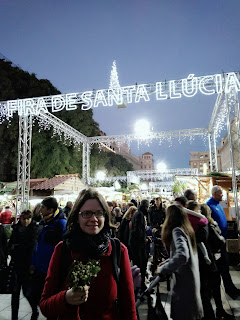
Christmas market--mistletoe in hand!
Barcelona's major Christmas market is the Fira de Santa Lucía, in the plaza of the Cathedral of Barcelona. The stands can be divided into 3 categories: plants, Nativity scenes, and miscellaneous gifts. The plant stands all sold holly, mistletoe, pines, and Caga Tiós. (Caga Tió, by the way, is one of two ¨crappy¨ Catalan Christmas traditions. It's a log with a face that children hit while singing a song so that it will crap them a present. At the market there was a giant Caga Tió and the kids took turns hitting it. ¨Shit me a gift!¨ Now there's a tradition that could go global!) The tiny Caga Tió's were cute, but I opted for a bunch of mistletoe. My first real mistletoe! I asked the vendor if they had the tradition of kissing underneath it. He said no, the Romans used it to bring luck to anyone who entered the house. Any other traditions were an invention. (I enforced our mistletoe kissing tradition at home regardless.)
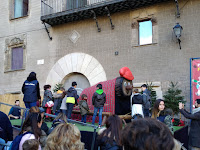

Shit us a gift, Tió!
The Nativity scene stands had what you might expect...holy families, shepherds, wise men...as well as caganers. The caganer is the second ¨crappy¨ Catalan Christmas tradition. It's a little figurine hidden in all nativity scenes of a man taking a crap. Normally he was dressed in Catalan traditional garb. But nowadays, they have entire stands dedicated to curious caganers: every celebrity under the sun (athletes, politicians, musicians) plus tv show/videogame characters (Spongebob, Spiderman). You name it, there's probably a figurine of it crapping. I picked a few up as gifts, just for laughs.

Santa María del Mar
Known as the Catedral del Mar, this basilica was built by the people, for the people in the 14th century. The novel revolving around it -- La Catedral del Mar, recommended reading-- is what drew me to visit. I wouldn't say I liked it more than the Sagrada Familia. But visiting it at night with the candles lit (and getting in for free!) gave it a very different vibe. Grandiose.

Flying solo
It's unanimous: travelling alone is an experience everyone should have. Luckily I'm still at an age where I can stay at a hostel and feel comfortable socializing with my peers (when I'm in my 40s, maybe not so much). I really enjoy being able to do what I want, when I want. Also having no pressure if I get lost (and no one to blame but myself if I do). Of course the benefit of staying at a hostel is that you can easily make plans with other travellers in the same boat. Cultural visits alone are no problem for me, despite my inability to take a decent selfie. But eating a sit-down meal alone doesn't feel right. To take care of that, one night I had dinner in the hostel with fellow travellers, and another night I went out with my roommates. I didn't mind, however, having lunch by myself in a cheap, cramped bar that seemed authentic enough. It gave me time to journal.

venres, 11 de xaneiro de 2019

A Visit from the Apalpador

Nowadays, it seems every country has it's own version of Santa Claus. I always appreciated Spain for being different in that regard, since they traditionally receive gifts on 3 Kings Day rather than on Christmas. Caspar, Melchior, and Balthazar show up on a camel on the night of January 5th. That evening, in most cities people line the streets to welcome them with a parade. Each king has a float, complete with pages throwing candy to their adoring fans.

But the times they are a-changing, and not purely because of globalization. More and more Spanish families are celebrating with Papá Noel, Santa's Spanish counterpart. Their reasoning is that by giving kids gifts on December 25th, they have weeks of vacation to play with their new toys, compared to the single vacation day for toys received from the Kings. Fair enough.

In Galicia, however, there has been a surge in popularity of a specifically Galician Christmas character: the Apalpador. Apalpador translates to the guy who pats. He's a burly coal maker from the Ancares (or O Caurel), mountains in the eastern part of Lugo province. Once a year, he comes down from the mountains to visit the children of Galicia. He pats their bellies to see if they've been well-fed, and gives them some magic chestnuts to be well-fed and strong all year round. Now, when I first heard the story, it was rather alarming. A strange man rubbing kids' tummies...Call the cops! But now that I've seen the Apalpador in action, it's cute and not creepy.


This year, the Apalpador was spotted in several Galician cities, and even more towns and villages. In Lugo, where he has been going for years, he was greeted by a horde of delighted children. In Pontevedra where he is a relative newcomer, I met him and participated in his walk around town. More and more children must learn about him in school, because quite a few recognized him in the street. Others (like myself originally) were skeptical about this big, bearded man approaching them. But they quickly relaxed when a girl their own age (the Apalpador's unofficial helper) gave them chestnuts.

If in Spain they're going to lose the tradition of the 3 Kings, I hope at least it gets replaced by an original, traditional character like the Apalpador.

sábado, 22 de decembro de 2018

Feira Franca

Pontevedra, like almost all Galician cities, has its own historical festival. Feira Franca is a Medieval fair celebrated every September. The name comes from the Middle Ages when Pontevedra was granted permission for a month-long market free of taxes. For the past two decades, this one-day blast from the past has completely transformed the city.

The first time I went, last year, I was amazed by the fact that everyone was dressed up. I love festivals that require costumes, so Lugo's Roman/Celtic fair Arde Lucus is another one of my favorites. But there its reputation has made it blow up, attracting visitors who come as tourists without costumes. Pontevedra, on the other hand, seemed to have kept it a secret. Requiring vendors to dress with the theme helps. But this year, there were a few more people dressed in modern clothes. I guess the cat's out of the bag!

Friday night, several knights ride into town on horses, to read the proclamation. That the next day commences Feira Franca! Saturday is full of activities for the whole family: an obstacle course and theatrical performance for kids; Medieval stands to peruse; jousting tournaments; Medieval dance class; spectacles and roving bands. Once again we rented a table in the old town for lunch and to rest our weary feet throughout the day. Some restaurants go all out for their lunch guests on the terrazas. It's fun to see decked out banquets, fit for the Medieval nobility seated at them. Groups of friends can also set up their own Medieval lunch under tents in the tree-lined promenade of the city center.


This year my favorite part of Feira Franca was the Medieval dance. First the professionals danced. Then, with A Peregrina church for a background, a few dozen of us (mostly commoners, some nobles) pranced around in wide skirts or breeches. The most intimate contact was grasping of hands as we danced. Scandalous! Maybe next year we'll choreograph something to the sound of lutes and harpsichords-- something to amaze the troubadours.

The fun continued on to the wee hours of the night. It ended in a bar with a movie screen which was showing none other than ¨Monty Python and the Holy Grail.¨ Relevant.